Claimed Without Permission: What to Do When a Stranger Crowd Decides Your Work Is Theirs
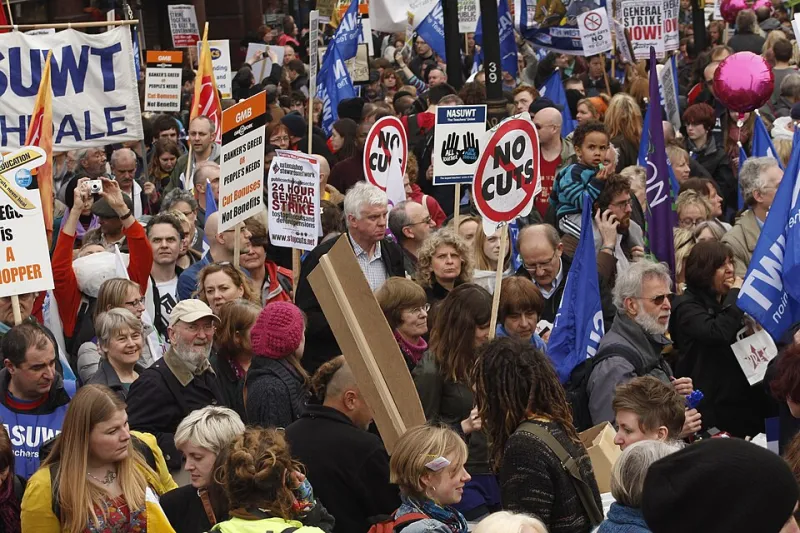
Photo: Weldon Kennedy from London, UK, CC BY 2.0, via Wikimedia Commons
You made something for one person. Maybe it was even for yourself. And then a completely different group of people showed up, planted a flag in it, and said: this is ours now.
It's disorienting. Sometimes it's flattering. Sometimes it's genuinely uncomfortable. But here's the thing nobody tells you early enough in a creative career—that moment of unexpected adoption might be the most clarifying thing that ever happens to your work.
The Hijack That Isn't Really a Hijack
Let's be clear about something first: when an audience claims your work, they're not stealing it. They're interpreting it. And interpretation is the whole game.
Take Bruce Springsteen's "Born in the USA." He wrote a brutal, gut-punch of a song about a Vietnam vet grinding through a system that chewed him up. Reagan's campaign team heard something completely different—a chest-thumping anthem—and tried to use it accordingly. Springsteen had to publicly object. The song got claimed by exactly the crowd it was criticizing.
Or look at how Joy Division's catalog got absorbed into goth subculture decades after Ian Curtis died. The band itself had a pretty specific post-punk identity. But a whole new community decided the music mapped perfectly onto their aesthetic and emotional world. Was that wrong? It expanded the work's reach across generations.
The point isn't that misreading is good. The point is that the gap between intent and reception is where something real lives.
Why the Wrong Crowd Sees Something True
Here's a counterintuitive idea worth sitting with: communities that weren't your intended audience often respond to what's actually in the work rather than what you said it was about.
Your intended audience comes with context. They know your influences, your references, maybe even your personal history. They're reading the work through a frame you helped build. That's useful, but it also means they might be seeing your explanation of the work as much as the work itself.
A stranger crowd has none of that. They just have the thing you made. And sometimes they find something in it you buried so deep you forgot it was there.
Visual artist Cady Noland spent years making work about American violence, consumerism, and the mythology of celebrity. Her pieces ended up getting collected and displayed by ultra-wealthy collectors in contexts that felt, to her, antithetical to the work's critique. She found it so intolerable she began legally fighting the resale of her pieces. The tension between her intent and how her audience used the work became its own story—arguably a more powerful one than the work alone.
That friction? That's not failure. That's the work doing something.
The Creator Who Leans In
Some creators, when they discover an unexpected audience, run toward it.
RuPaul built a career that originally landed in underground drag and queer nightlife spaces. As mainstream visibility grew, a completely different demographic—suburban teenagers, middle-aged women, reality TV fans—claimed RuPaul's Drag Race as their own. The show became something it was never originally positioned to be. RuPaul leaned in, and the result is a cultural institution.
Or think about how lo-fi hip-hop—originally rooted in a pretty specific corner of music nerd culture—became the default study soundtrack for millions of college students who couldn't name a single producer behind it. The creators who kept making it didn't pivot away from their craft. But some of them started thinking differently about what the music was for. That recalibration produced some genuinely interesting creative evolution.
Leaning in doesn't mean abandoning your original vision. It means being curious enough to ask why this particular crowd showed up.
The Question Worth Asking
When a community you didn't expect starts claiming your work, the instinct is often defensive. They don't get it. That's not what this is about. They're missing the point.
Maybe. But it's worth asking a harder question first: what did you put in there that made them feel like it was made for them?
Because something in your work resonated. Something felt like recognition. And that recognition—even if it's not the recognition you were aiming for—is a signal worth following.
Writers talk about this all the time. A novelist writes what she thinks is a story about grief, and readers keep calling it a book about motherhood. She didn't intend that. But when she looks closely, she can see exactly how they got there. That gap between her intention and their reading taught her something about her own subtext that she couldn't have learned any other way.
When It Actually Hurts
None of this is to say every unexpected audience claim is a gift. Sometimes it genuinely isn't.
When white nationalist groups started using certain folk and metal artists' imagery and music to signal group identity, those artists had to make real choices about how to respond—publicly distance themselves, change their visual language, or in some cases, shut down projects entirely. The wrong crowd can do real damage, especially when the work gets used to harm people.
The difference between uncomfortable friction and actual harm is worth taking seriously. Not every misreading is creative opportunity. Some of it requires a clear, public no.
But short of that threshold, the discomfort of being claimed by an unexpected community is usually worth sitting with rather than rejecting outright.
Half the Work Is Letting Go
There's a reason this site is called Half Adams. Somewhere between what you make and what gets received, control slips away. That's not a bug. That's the nature of putting work into the world.
You get to own the making. You don't get to own the meaning—not completely, not forever. The audience, including the one you never asked for, is going to do something with what you gave them. And sometimes what they do with it is more interesting than what you planned.
The creators who grow through their careers tend to be the ones who stay curious about that gap. Not bitter about it. Not defensive. Just genuinely interested in what the unexpected response is trying to tell them.
So if some crowd you didn't design for has decided your work belongs to them—pay attention. They might be pointing at the most honest thing you ever made.