Neither Here Nor There: How the Space Between Mediums Becomes Your Strongest Creative Identity
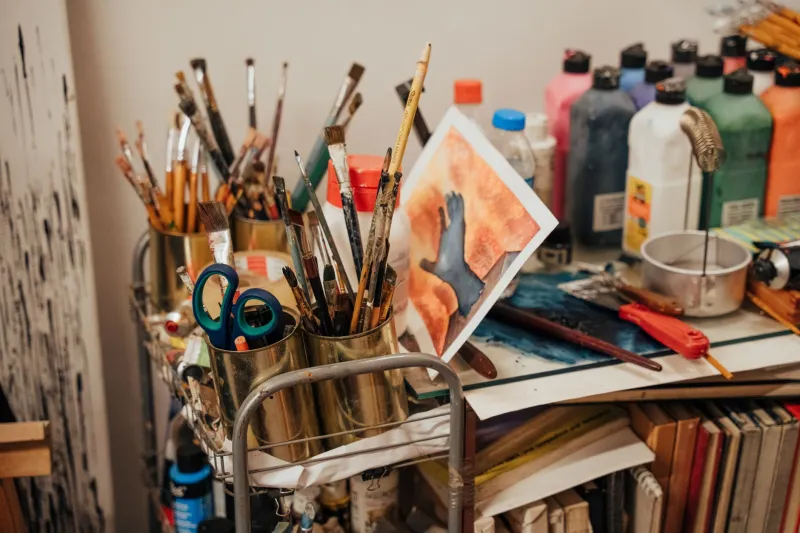
There's a particular kind of anxiety that comes with not being able to answer the question "so, what do you do?" in a single clean sentence. Musicians who paint. Visual artists who produce records. Filmmakers who score their own work. They all know that pause — the one where the person across from them is waiting for a box to check.
But something interesting has been happening. That pause? It's starting to fill with curiosity instead of confusion. And the creators living in those in-between spaces are finding that the gap itself is the most valuable real estate in the room.
The Liminal Space Isn't a Waiting Room
For a long time, the creative world rewarded specialization. You were a photographer or a graphic designer. A singer-songwriter or a producer. The assumption was that depth in one lane led to mastery, and mastery led to relevance. And for a while, that tracked.
But the cultural conversation has shifted. Audiences — especially younger ones — are genuinely drawn to work that resists easy labeling. Not because ambiguity is trendy, but because the friction between two disciplines tends to generate something neither could produce alone.
Think about what happens when a musician approaches visual art with the same intuition they use to build a song structure. The rhythm of a composition, the tension and release of color, the way negative space functions like a rest between notes — those aren't metaphors. They're actual design decisions informed by a completely different training. The result is work that feels familiar and strange at the same time, which is pretty much the definition of memorable.
Real People, Real Gaps
Take someone like Solange Knowles. Easy to call her a musician, but that label doesn't come close to covering the territory. Her visual direction, her spatial installations, her approach to performance as a full-sensory environment — she's operating in a zone that doesn't have a clean name. And that's precisely why her work lands differently than almost anyone else making music right now.
Or look at the late designer Virgil Abloh, who moved between fashion, architecture, music, and visual art with what seemed like effortless fluidity. He wasn't a master of all of them in the traditional sense. He was a master of the conversation between them. The seams he left visible — literally and figuratively — were the point.
Closer to the underground, you've got producers like Arca, whose work exists somewhere between electronic composition, performance art, and visual identity in a way that makes genre tags feel almost insulting. The music and the visuals aren't separate projects. They're the same project expressed through different materials.
Why the In-Between Works
Here's the practical case for threshold living as a creative: when you operate inside a single discipline, you're solving problems using that discipline's established toolkit. The solutions you find are often good, sometimes great, but they're legible to everyone else working in the same space. The vocabulary is shared.
When you bring two toolkits into conversation, you start solving problems in ways that specialists in either field wouldn't have thought to try. A visual artist who thinks in sound might use silence the way a painter uses white space — not as absence, but as active presence. A musician who draws might approach melody the way they approach line weight, adjusting pressure and emphasis in ways that feel instinctive rather than theoretical.
The cross-contamination is the innovation. It's not about being mediocre at two things. It's about letting two ways of seeing collide until something new falls out.
The Audience Is Catching Up
For years, the concern was that audiences needed clear categories to find your work, engage with it, and recommend it to others. That concern wasn't wrong — discoverability still matters. But the way people actually experience creative work has changed pretty dramatically.
Social platforms have flattened the presentation of creative output. A musician's studio session video sits next to a painter's process reel sits next to an architect's sketch dump. Audiences are used to consuming creative work across forms simultaneously, often from the same person. The expectation that a creator does one thing is increasingly a relic.
What audiences are responding to now is a distinct point of view that holds across everything someone makes. When your music and your visual work and your writing all feel like they came from the same consciousness — even if they look nothing alike on the surface — that coherence is more compelling than technical mastery in a single lane.
How to Actually Live in the Gap
This isn't a call to dabble in everything and commit to nothing. The threshold position only works if you're genuinely engaged with both sides of the gap. Half-hearted experimentation in a second medium doesn't produce creative friction — it just produces diluted output.
The move is to take your primary discipline seriously enough that its logic becomes second nature, and then to bring that logic into a second medium with actual rigor. Not as a tourist. As someone who's genuinely trying to understand what the new territory can do.
It also means being honest about what you're building. If you're a musician who paints, your visual work doesn't need to compete with painters who've spent decades in the studio. It needs to be yours — shaped by how you hear the world, how you think about time and structure, how your ear translates into your hand. That specificity is the whole thing.
The Name You Can't Quite Say
There's something Half Adams has always understood — that the most interesting territory isn't fully on either side of the line. Art and sound. The space between. That framing isn't just aesthetic. It's a genuine creative philosophy.
The creators who are doing the most interesting work right now don't have clean job titles. They have a sensibility that runs through everything they make, regardless of medium. And when someone asks what they do, the answer is longer than one word — but it's worth the extra sentence.
Being between things isn't a problem to solve. For a lot of creators, it's the whole answer.