Never Arriving: Why Staying a Beginner Across Disciplines Is the Best Creative Move You Can Make
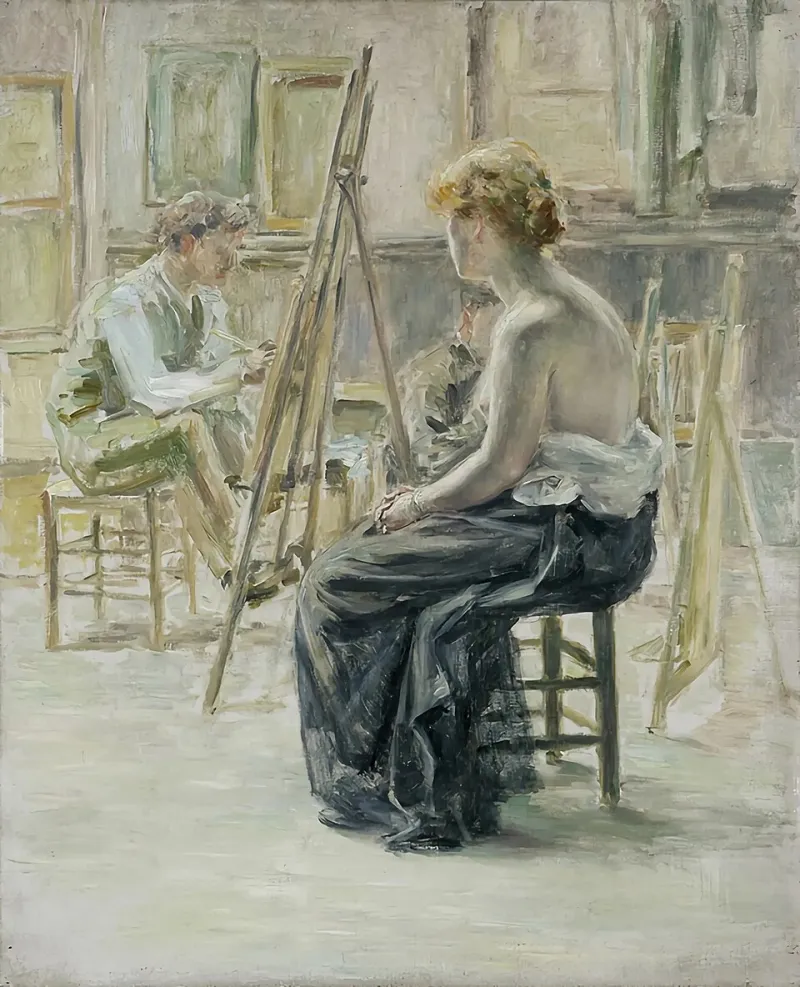
Photo: Kuroda Seiki, Public domain, via Wikimedia Commons
Somewhere along the way, we got sold a story. Master your craft. Ten thousand hours. Commit to the lane. Dig deep, not wide. It's advice that sounds responsible, almost virtuous — and for certain goals, it genuinely holds up. But for a lot of creative people, that same pressure to fully arrive at expertise has quietly become a cage.
There's something worth examining in the space between disciplines. In the gap between knowing enough and knowing everything. That in-between zone — half-fluent, half-fumbling — turns out to be one of the most generative places a creative person can live.
The Problem With Mastery (Or At Least, Full Mastery)
Mastery is seductive. There's real satisfaction in getting good at something, in moving from confusion to competence. Nobody's arguing against that. But complete mastery carries a shadow side that doesn't get talked about enough: it narrows the aperture.
When you've fully internalized the rules of a discipline, you also internalize its blind spots. The conventions start to feel like gravity — invisible, automatic, unchallengeable. A classically trained composer might hear a lo-fi bedroom track and instinctively clock everything it's doing wrong before they hear what it's doing right. A veteran graphic designer might dismiss a piece of visual art that breaks every layout principle they've spent years respecting. Expertise, at a certain depth, teaches you what's supposed to work. And that can make it genuinely harder to see what does work.
The creators who tend to make things that feel new often aren't the deepest specialists. They're the ones who've collected just enough fluency across multiple worlds to move between them without fully belonging to any one.
What 'Half-Expert' Actually Looks Like
Think about someone like Phoebe Bridgers. She's a musician, clearly — but her work is soaked in cinematic sensibility, in the visual logic of a record cover or a stage set or a music video that feels like it came from a filmmaker's brain. She's not a professional cinematographer. She doesn't need to be. She knows enough of that language to let it reshape how she writes and arranges. The half-expertise is the point.
Or look at what happened when producers from the electronic world started wandering into hip-hop, or when visual artists started releasing ambient records, or when novelists started making podcasts that feel more like audio fiction than journalism. The most interesting stuff almost always comes from someone who showed up to a discipline without fully checking in. They brought the wrong toolkit, and the friction made something new.
This isn't a fluke. It's a pattern.
The Liminal Space Is Where the Ideas Live
There's a concept in anthropology called liminality — the threshold state between what you were and what you're becoming. It's inherently uncomfortable. You're not quite the old thing, not quite the new thing. Most people try to get through it as fast as possible.
But creatively? That threshold is where the interesting collisions happen.
When you're learning to play an instrument after years of making visual art, you bring a spatial, compositional instinct to sound that a lifelong musician might not have. When you're writing your first screenplay after years of recording music, you think about pacing and tension in ways that surprise screenwriters who've only ever worked in the form. The half-knowledge isn't a liability. It's a lens.
Being perpetually in-process across multiple disciplines means you're always carrying a fresh set of questions into whatever room you walk into. And questions, honestly, are more useful than answers in most creative contexts.
The Practical Case for Staying Unfinished
Beyond the philosophical argument, there's a pretty concrete economic case for this in today's creative landscape. The market for a single-discipline specialist is narrowing in some fields and expanding in others — but the market for someone who can think across art, sound, writing, and digital space simultaneously? That's genuinely growing.
Content creation, independent music, brand storytelling, podcast production, visual identity work — so much of what's being built right now requires people who can hold multiple creative vocabularies at once. Not mastery in each. Fluency. Enough to communicate, enough to collaborate, enough to translate one discipline's logic into another's language.
The half-expert is, in a lot of ways, the ideal creative collaborator for how work actually gets made in 2024. They're not precious about their expertise because they don't have a single expertise to protect. They're comfortable being the person in the room who doesn't fully know what they're doing — because they've been that person in multiple rooms and learned to trust what comes out of that discomfort.
Giving Yourself Permission to Stay in the Middle
None of this means you shouldn't get good at things. Get good at things. Absolutely. But maybe reconsider the finish line.
If you're a musician who's been quietly sketching or painting on the side — stop treating that as a hobby that's wasting time you should be spending on music. That visual practice is changing how you hear. It's changing what you make. The same goes for the visual artist who's been messing around with Ableton on weekends, or the writer who keeps trying to learn basic video editing even though they feel like they're terrible at it.
You're supposed to feel like you're terrible at it. That's the state you want to stay in a little longer than feels comfortable. The awkward, half-formed fluency is the thing doing work under the surface, even when it doesn't look like it.
Half Adams, Half Everything
There's something in the name of this site that's always felt honest about this exact tension. Half. Not incomplete in a failed sense — half in the way that a half-open door is more interesting than one that's shut tight. Half in the way that art and sound exist in a permanent conversation with each other, neither one fully containing the other.
The most compelling creative work often lives in that exact proportion. Not fully one thing. Not fully another. Something in between that doesn't have a clean category yet.
If you've been waiting to feel finished before you start calling yourself a real artist, a real musician, a real writer — consider the possibility that the waiting is the problem. The half-finished version of you, wandering between disciplines with a notebook in one hand and a half-learned skill in the other, might be doing exactly the right thing.
Stay in the middle. The middle is where it happens.